Commercial Design for Consistent Batch Quality
Most breweries do not lose customers because one batch was bad; they lose them because two batches of the same beer tasted different. HGMC publishes large commercial brewery plant up to 100 HL of brew length, with hot products in the 20 T–50 T band and a PLC fully automatic control panel that indicates curves and prints production records. Repeatability is designed in before the first vessel is rolled, and the record sheet is what proves it afterwards.

Key takeaways
- HGMC publishes large commercial brewery systems up to 100 HL, with 20 T–50 T systems among its hot products.
- The fully automatic PLC panel indicates curves and prints production records for each brew.
- Fabrication is published as TIG 100% full welding joints with polishing accuracy of ≤0.4 μm.
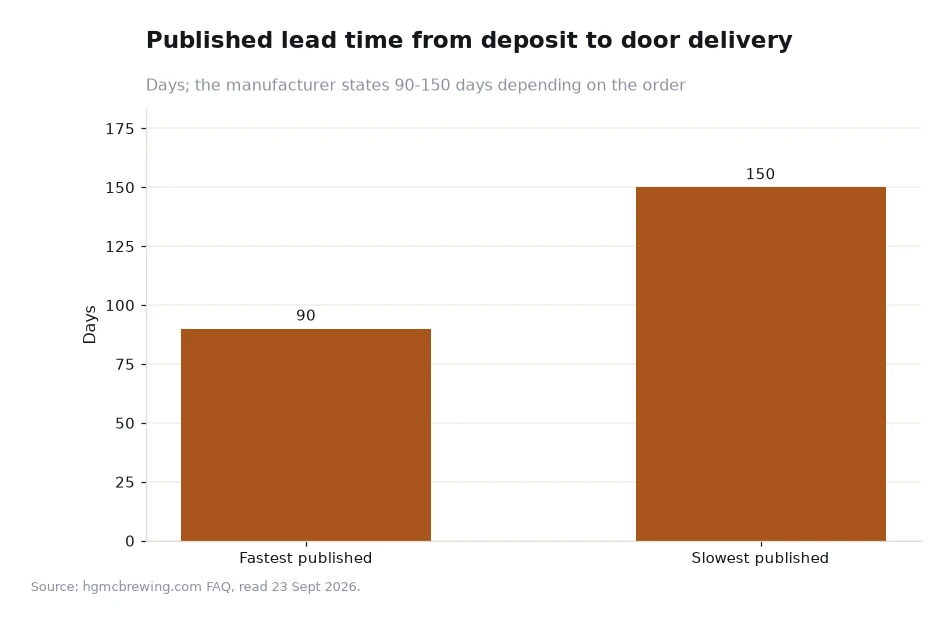
- Published lead time is 90–150 days from deposit to door delivery, depending on the order.
What consistent quality really measures
Consistency is not a flavour claim; it is the size of the variation between brews. Two batches are the same beer when the mash temperatures, the lautering time, the boil, the whirlpool rest, the fermentation temperatures, the carbonation level and the packaging day all land inside the same windows. Every one of those windows is a design decision, and a plant that leaves any of them to memory will drift as the team grows.
The commercial argument is simple. A brewery that sells through a distributor or a supermarket chain has to answer questions about a batch that arrived thin or late. A plant built around repeatable steps answers those questions with a curve and a date instead of an opinion, which is worth more than the small saving from leaving automation out of the order.
Design choices that remove variables
HGMC publishes several design points aimed squarely at variation. Mash, wort and water flow run automatically with automatic temperature control, so flow rates do not depend on how far a valve was opened by hand. The steam system is designed as a whole rather than assembled from parts bought separately, which keeps heat input steady across a boil. Piping is designed to avoid wort aeration, and the vessels carry specially designed jackets on both the body and the cone, with a bigger headspace whose volume is calculated separately from the working volume.
Construction details matter for the same reason. The published fabrication standard is TIG 100% full welding joints with polishing accuracy of ≤0.4 μm on stainless steel 304 or 316, using SUS304 food-grade material certified by SGS. A smooth, fully welded wetted path cleans more predictably, and predictable cleaning is what stops the flavour of last week's stout appearing in this week's lager.
The site also states that its beer brewing equipment is designed around the customer's own brewing method and beer types and can handle beer up to 33 Plato. That is a statement about the recipe range the plant has to carry, not only about its size.
Records as the backbone of repeatability
The PLC fully automatic control panel is the piece that turns a good brew day into a repeatable one. Curve indication shows what the mash and wort temperatures actually did, and production-record printing writes it down without an operator transcribing numbers at the end of a long shift. Those records are the raw material for every later argument about quality, whether it is a retailer asking for documentation or a brewer asking why the fourth batch of the week finished differently.
Records also shorten training. A new brewer can read the last twenty brews of a recipe as a curve rather than as a set of written targets, and can see which step usually runs long. HGMC publishes operator training as part of its service list, alongside installation, commissioning, maintenance support and spare parts supply, which fits the same pattern: the plant is supplied with the knowledge to run it as designed.
Scaling the design up without losing the recipe
Growth is where consistency usually breaks. A brewery that doubles its brew length finds that a step which took fifteen minutes at the old size takes longer at the new one, and the recipe has to be adjusted rather than scaled. Designing the larger plant with the same control architecture as the smaller one keeps that adjustment measurable instead of mysterious.
When a brewery steps up a size class, commercial brewery equipment is usually re-specified rather than simply enlarged, because a longer boil or a slower transfer changes the recipe. HGMC publishes commercial brewery sizes from 1 HL to 500 HL and states that complete breweries are its specialty, which is why the published reference installations run from 200 L to 20 T. A brewery moving from a 1,000 litre kit to a 20 T plant is not buying a bigger version of the same thing; it is buying the control and the records that make the larger scale behave the same way.
Published reference installations
| Published case | Country | Published size |
|---|---|---|
| Large beer equipment system | Poland | 20 T |
| Brewery installation | France | 3,500 L |
| Brewery installation | England | 2,000 L |
| Brewery installation | Korea | 2,000 L |
| Brewery installation | Canada | 1,000 L |
Worked example: what a slow delivery costs in output
Assume a commercial plant with a 50 HL brew length — comfortably inside the published ceiling of 100 HL for large commercial systems — brewing three times a week. The published delivery window is 90–150 days from deposit to door delivery, so the spread inside that window is 150 − 90 = 60 days, or about 8.6 weeks.
At three brews a week, 8.6 weeks is 8.6 × 3 = 25.8 brews. At 50 HL each, that is 25.8 × 50 = 1,290 HL of production that an order landing on day 150 yields only after the order landing on day 90 has already been brewing for two months. Put the same figure in barrels at 1 BBL ≈ 117 litres: 1,290 HL is 129,000 litres, and 129,000 ÷ 117 = about 1,103 BBL. Every number is an example with its assumptions written down, but it shows why the delivery date belongs in the quality conversation: a plant that arrives late cannot be consistent, because it is not yet running.
Frequently asked questions
How large is a large commercial brewery system at HGMC?
The large commercial page publishes equipment up to 100 HL, within an overall published capacity range of 100 L to 200 T. Systems of 20 T to 50 T are listed among the hot products.
Does automation really change batch consistency?
It removes the hand-driven variables: flow rates, step times and heat input. The fully automatic PLC panel also indicates curves and prints production records, so each brew can be compared with the last one.
Design the records before the vessels
Decide which measurements will be recorded on every brew, who will read them and how long they will be kept, then specify the control level that produces them without extra work. A record that has to be written by hand at the end of a shift is a record that stops being written in a busy month.
Then use the published design service. HGMC offers 2D, 2.5D and 3D design work covering the brewery space layout and the brewhouse vessel and piping design, free of charge, which is the lowest-cost point at which to test whether a layout supports the sequence your recipe needs. The HGMC site sets out the equipment families, the turnkey plant pages cover complete systems, and the brewhouse equipment listing covers the hot side where the mash sequence lives.
System sizes, fabrication details, control levels, reference installations and the lead time above come from the manufacturer's own website, read 23 Sept 2026, and the output arithmetic is our own example with every assumption stated in the text.[1] Confirm capacity, control package and schedule against your own enquiry.