Documents and Compliance: What to Collect Before a Fragrance Launch
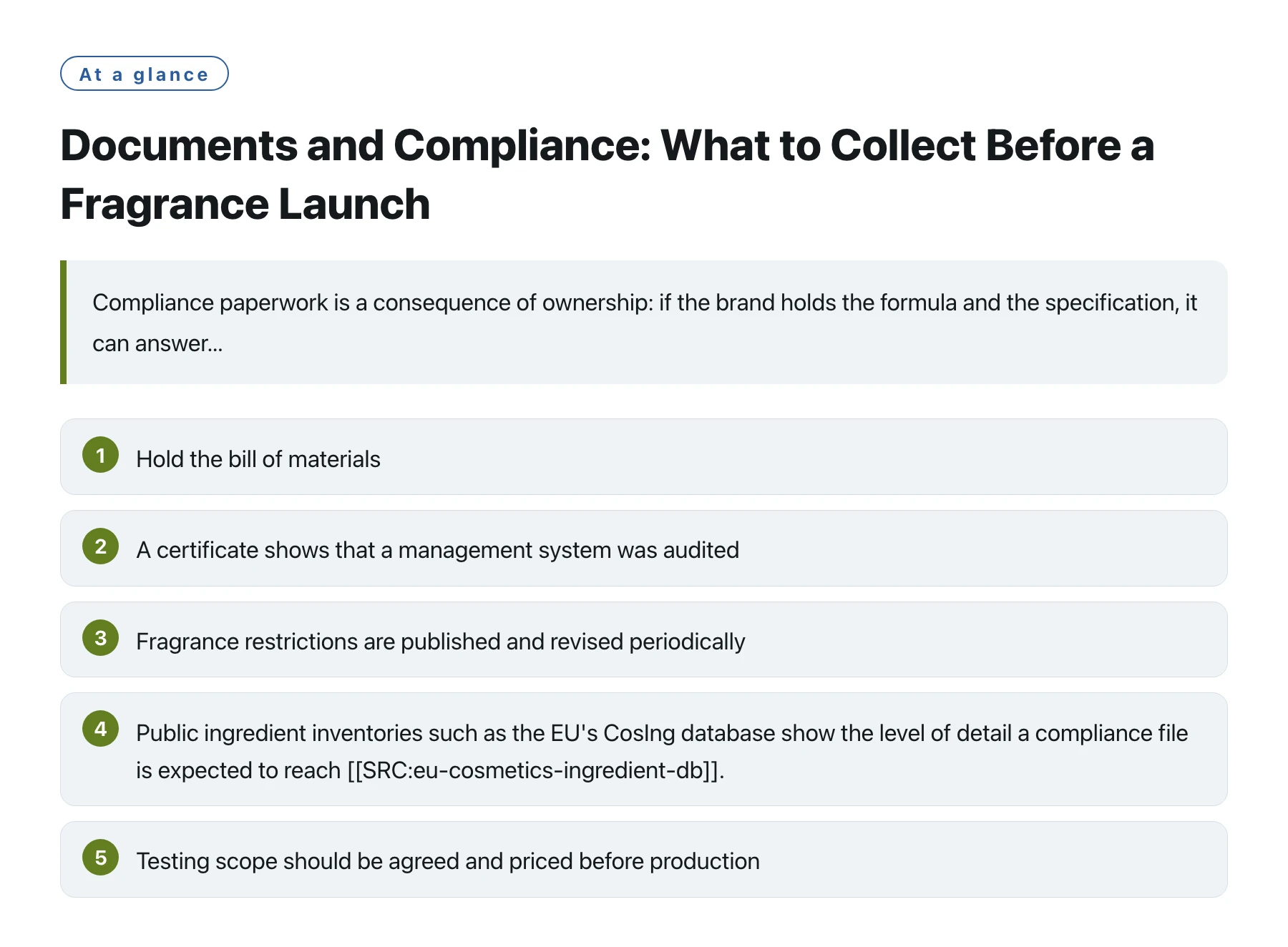
Compliance paperwork is a consequence of ownership: if the brand holds the formula and the specification, it can answer a regulator, an importer or a retailer without waiting on a supplier. If it does not, every compliance question becomes a project. Before a launch, the goal is not a thick folder — it is a folder the brand can read, explain and update on its own.
Key takeaways
- Hold the bill of materials, the filling specification and the approved sample record yourself, because those three documents answer most questions that arrive after launch.
- A certificate shows that a management system was audited; a batch record shows what happened on a specific run, and buyers usually need both.
- Fragrance restrictions are published and revised periodically, so a documentation pack is a living set rather than a one-time collection [1].
- Public ingredient inventories such as the EU's CosIng database show the level of detail a compliance file is expected to reach [2].
- Testing scope should be agreed and priced before production, because a test requested after shipping is a delay rather than a document [3].
Brands tend to treat compliance as a final gate: the product is ready, now someone checks the paperwork. That ordering is why so many launches stall. Documents are generated during development, sampling and production, and the party who holds them is decided by the ownership terms rather than by the compliance department.
The practical question, then, is not which certificate to ask for, but which documents the brand needs to own — and what each one can and cannot demonstrate.
Ownership decides how painful compliance will be
If the formula and the specification sit with the manufacturer, every downstream question routes through them: a retailer asking about an ingredient, an importer requesting a declaration, a customer complaint that needs tracing back to a batch. Each request becomes a message, a wait and a reply that the brand cannot verify. None of these are unusual events; they are the ordinary traffic of selling a fragrance.
Holding the file yourself reverses the flow. The brand can answer directly, and when the answer is uncertain, it knows exactly which document is missing rather than waiting to be told. This is the strongest practical argument for settling formula ownership early, and it has very little to do with secrecy.
If you do not hold the file, you do not hold the argument
There is a second consequence. When a batch drifts, or a component fails, or a market asks for something new, the brand's position depends on what it can show. A supplier relationship is commercial, and commercial relationships are easier to resolve when both sides are looking at the same documents. A brand without the file is not negotiating; it is asking. The gap is widest in private label fragrance production, where the brand's name is on the pack while the technical file ordinarily stays with the manufacturer.
The document set, and who should hold it
| Document | Issued by | What it establishes | Common gap |
|---|---|---|---|
| Bill of materials | Development or the brand | What the product is made of, at what proportions | Delivered as a product code rather than a readable list |
| Filling and pack specification | Production | Fill volume, tolerances, components and their dimensions | Not updated after a component substitution |
| Approved reference sample | Both parties | The physical standard the bulk must match | Held by one party only, or unlabelled and undated |
| Batch record | Production | What happened on a specific run, and who signed it | Not requested until something goes wrong |
| Stability and compatibility reports | Internal or third-party laboratory | How the product behaves over time and in contact with its pack | Requested late, so it delays rather than de-risks |
| Certificates and declarations | Certification body or supplier | The management system and the material declarations | Treated as proof of product-level compliance |
| Label artwork and text | Brand, checked against the market's rules | What the consumer is told, in the required form | Approved only as a proof image, with no editable source |
The right-hand column is where launches actually break. Each gap is cheap to close during development and awkward to close after a shipment has left.
Labelling, concentration and the limits of disclosure
Fragrance labelling is a good illustration of how ownership and compliance interact. In several markets, fragrance components may be declared collectively rather than individually, which is convenient for the brand and unhelpful for the buyer — the product says fragrance, and the detail sits in a document that someone has to hold. Some jurisdictions require specific allergens to be named above defined thresholds, which means the brand has to know what is in the concentrate even when the label does not say so.
The concentration of the fragrance also changes what the label has to communicate and how the product performs, and it is one of the first things a retailer or an importer will ask about. Understanding what the concentration on a perfume label means is therefore not a marketing exercise, it is a compliance input: the same formula at a different concentration can trigger different labelling obligations and a different stability profile.
The reference standard for what may be used is published and revised. The International Fragrance Association maintains a standards library that restricts or prohibits specific materials according to product category and use level [1]. Because it is revised periodically, the compliance question is not whether the formula passed once, but who is responsible for checking it again when the standard changes.
Regulators also publish ingredient inventories. The European Commission's CosIng database is the clearest public example of a searchable inventory of cosmetic ingredients, and it is a useful benchmark for the level of naming detail a well-kept file contains [2]. A formula documented at that level of precision is far easier to defend in a conversation with an authority than one described by trade names alone.
Testing: agree the scope before production, not after
Testing is the document line most often postponed, because it has no visible product attached. That is a mistake in sequencing. Stability and compatibility studies measure change over weeks, and a test commissioned after a container has shipped cannot influence that shipment — it can only explain it.
Third-party laboratories set out the scope of cosmetic and personal care testing they offer, covering areas from microbiology to packaging compatibility [3]. Asking a supplier to price a defined test plan alongside the production quote turns testing into a planned cost, and it also produces a useful comparison point: two suppliers quoting the same unit price may be quoting very different documentation.
The same principle applies to declarations. Material declarations, allergen statements and packaging declarations all originate upstream, and collecting them during development is routine; collecting them under a retailer deadline is not.
A single-page document register, with columns for document, holder, version and date, prevents most launch-day confusion. It takes twenty minutes to create and it is the fastest way to see which items you cannot actually obtain.
What to ask for before the first shipment
Work through the register with the supplier and ask for anything you cannot currently produce yourself. In practice, the list narrows to four requests: the readable bill of materials, the filling specification, one batch record from a comparable run, and a testing plan with the laboratory named. If a supplier cannot provide those, the compliance burden is not a documentation problem — it is a capability question.
It is worth applying the same standard to any partner you are considering, including the Xuelei brand. The brand carries the commercial consequences of a compliance failure regardless of who holds the paper, which is the reason to hold the paper.
Finally, build a review rhythm. Once a year, check that the formula has been re-screened against the current restrictions, that the specification still matches the components actually being bought, and that the document register has no blanks. A compliance file is not finished when the product launches; it starts then.
Sources
- IFRA Standards Library (International Fragrance Association) —— The IFRA Standards Library lists the restrictions the fragrance industry applies to individual fragrance ingredients, based on safety assessments; it is the reference point for compliant fragrance formulation.
- EU CosIng — Cosmetic Ingredient Database (European Commission) —— The European Commission's CosIng database of cosmetic ingredients, listing ingredient functions, restrictions and labelling requirements under EU cosmetics law.
- SGS: Cosmetics, Personal Care & Household Testing —— Testing, inspection and certification services for cosmetics and personal care, including microbiological, stability and safety testing aligned with cosmetics GMP.
Frequently asked questions
Which documents should a perfume brand own outright?
At minimum the bill of materials, the filling and pack specification, the approved reference sample, one batch record and the label artwork source files. Together they allow the brand to answer routine questions without a supplier's involvement.
Do I need a certificate to sell a fragrance?
Not as a product requirement. Certificates describe management systems, not individual products. What a market usually requires is a correctly labelled product, a safety assessment or notification where applicable, and the ability to substantiate the claims on the pack.
How often should a formula be re-checked against fragrance standards?
Whenever the relevant standards are revised, and at least annually if the product is on sale for several years. The revision cycle is not in the brand's control, so the practical approach is to put the check in a calendar rather than rely on notice.
Is a private label arrangement different from OEM in documentation terms?
The obligations on the brand are broadly similar, but the technical file is more likely to stay with the manufacturer. That makes the document register more important, not less, because the brand has to specify what it needs rather than assume it will receive it.
What is the most common documentation failure at launch?
An approved sample that nobody can reproduce: no retained physical reference, no dated record and no agreed tolerances. It is also the failure that most often turns a minor batch variation into a commercial dispute.